You have a business idea that could genuinely change things. Maybe it solves a problem you’ve lived with for years, or maybe you spotted a gap in the market that nobody else has filled yet. Either way, you’re stuck at the same wall most founders hit: how do I actually build this without burning through a runway before I’ve proven anything MVP Development?
The answer most successful startups have landed on is an MVP a Minimum Viable Product. But even knowing that, the question remains: how long does it actually take, and how do you make sure you’re not still “in development” six months from now?
At RemoteDev.uk, we’ve helped UK startups and growing businesses launch MVPs in as little as six weeks. This post breaks down exactly how that timeline works week by week so you know what to expect and how to prepare.
What Is an MVP, Really?
Before we get into timelines, let’s clear something up. An MVP is not a half-finished product. It’s not a rough prototype held together with duct tape. It’s the leanest version of your product that still delivers real value to real users.
The core idea, borrowed from Eric Ries’ Lean Startup methodology, is simple: don’t build everything. Build the one thing that proves your hypothesis. Ship it. Learn from it. Then decide what to build next.
A strong MVP has three qualities
- It solves one specific problem for one specific group of users
- It’s functional enough to collect genuine feedback
- It’s built fast enough that pivoting is still affordable if needed
Six weeks is enough time to do exactly this if you go in with a clear plan.
Why 6 Weeks? The Logic Behind the Timeline
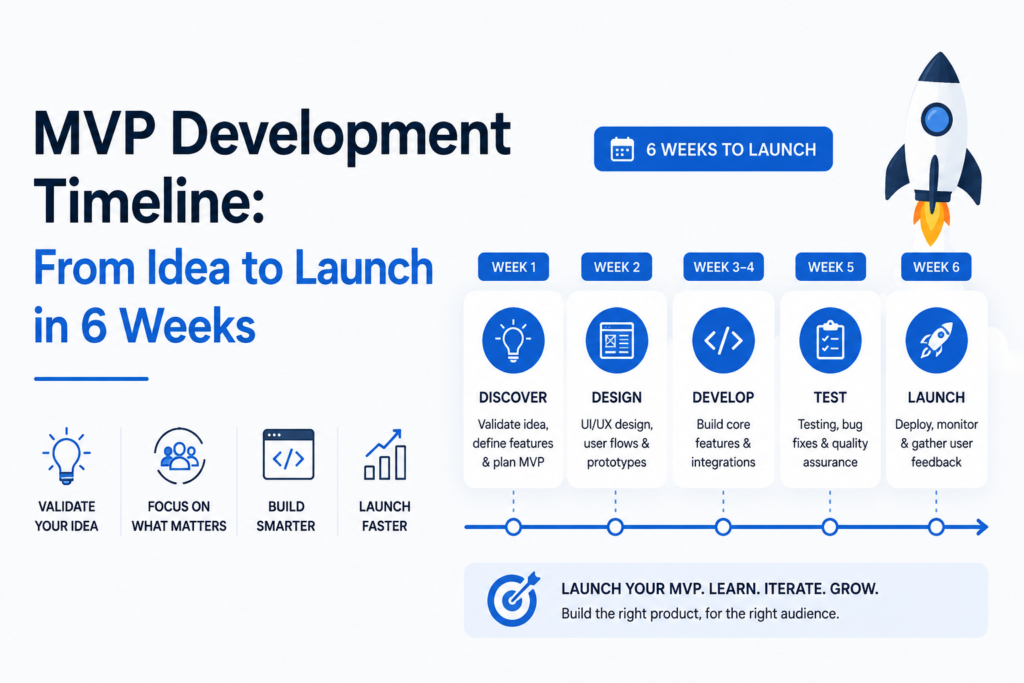
Six weeks isn’t an arbitrary number. It maps to a natural rhythm of product development when you strip out the unnecessary.
- Weeks 1–2: Discovery, scoping, and design
- Weeks 3–5: Core development sprints
- Week 6: Testing, refinement, and launch prep
What makes it possible is working with a lean, experienced team that doesn’t need lengthy onboarding, hand-holding, or internal politics to move fast. When your development partner already knows how to build scalable web and mobile apps and has done it dozens of times the clock starts from day one, not week three.
Let’s walk through each phase.
Week 1: Discovery & Scope Definition
The biggest reason MVPs run over time and over budget is a vague scope. “We’ll figure it out as we go” is a costly philosophy in software development.
Week one is about turning your idea into a concrete, buildable specification.
What happens
- A deep-dive workshop with your development team to map out user journeys
- Identification of your core feature set what’s in, and just as importantly, what’s out
- Competitive analysis to avoid reinventing wheels
- Agreement on your tech stack (React Native for mobile? Custom web app? No-code hybrid with Bubble?)
- A written project brief that both sides sign off on
What you should bring to week one
- A clear description of the problem you’re solving
- Your target user (even a rough persona works)
- Any existing research, mockups, or notes you have
- Honest answers about your budget and hard deadlines
By the end of week one, you should have a document that answers: What are we building, who is it for, and what does “done” look like?
Week 2: UX Design & Prototype
With scope locked, the design team gets to work. Week two is about turning the written spec into something you can see, click through, and validate before a single line of production code is written.
What happens
- Wireframes for all core screens and user flows
- A clickable prototype (usually in Figma) showing the full user journey
- A design review session where you provide feedback
- Sign-off on UI direction before development begins
This step is where many teams skip ahead to “just start building,” and it almost always costs them. A design flaw caught at the wireframe stage takes an hour to fix. The same flaw caught in week five of development can cost days.
A solid prototype also gives you something tangible to show early investors, advisors, or potential users even before your product exists. That’s a genuine advantage.
Weeks 3–5: Core Development Sprints
This is where the product comes to life. Your development team works in one-week sprints, each with a defined goal and a demo at the end.
Sprint structure
Each sprint follows the same rhythm plan on Monday, build Tuesday through Thursday, demo and review on Friday. This keeps progress visible and gives you regular touchpoints without micromanaging.
What gets built
The specifics vary by product, but a typical MVP sprint plan might look like this
Sprint 1 (Week 3): Core architecture, authentication, and database setup. By the end of this sprint, users can sign up, log in, and reach the main dashboard.
Sprint 2 (Week 4): Primary feature development whatever the core value of your product is. If you’re building a booking platform, this is where booking works end-to-end. If it’s a SaaS tool, this is where the main workflow functions.
Sprint 3 (Week 5): Secondary features, integrations (payments, notifications, third-party APIs), and internal testing. Edge cases get handled. The product starts to feel real.
What makes this phase work
- Clear acceptance criteria for each feature (so “done” is unambiguous)
- Daily async standups to surface blockers early
- A staging environment where you can review builds in real time
- A project management tool where everything is tracked and visible
At RemoteDev.uk, we use lean agile processes that keep founders in the loop without requiring them to be available round the clock. You see progress. You give feedback. The team keeps moving.
Week 6: QA, Polish & Launch
The final week is about getting your MVP genuinely ready for the world not perfect, but professional.
Quality assurance
Your QA process should cover both functional testing (does it do what it’s supposed to do?) and usability testing (can real users actually figure out how to use it?). Automated tests catch regressions; manual testing catches the things users will inevitably do that no developer anticipated.
Performance and security checks
A slow MVP loses users fast. Before launch, run basic performance checks load times, mobile responsiveness, and database query efficiency. Equally important: make sure your user data is handled securely, particularly if you’re operating under UK GDPR.
Soft launch vs. hard launch
For most MVPs, a soft launch to a small group of early adopters before a full public release is the smarter move. It gives you real feedback in a controlled setting, lets you fix critical bugs before they affect thousands of users, and builds the kind of early community that generates genuine word-of-mouth.
What you should have at the end of week 6
- A live, functional product accessible to real users
- Basic analytics set up to track key metrics (signups, activation, retention)
- A feedback loop in place (even just a simple feedback form)
- A clear list of what you’ll build in the next phase, informed by what you’ve learned
Common Pitfalls That Blow Up MVP Timelines
Even with a good plan, certain mistakes consistently cause delays. Here’s what to watch out for.
Scope creep. The number one killer of fast MVPs. Every “can we just add one more thing?” conversation costs time. Discipline around scope is a feature, not a limitation.
Unclear decisions. If your development team has to wait two days for approval on a design choice, that’s two days lost from a six-week clock. Identify one decision-maker on your side and give them authority to move.
Changing the brief mid-sprint. Pivots are fine in fact, they’re expected. But mid-sprint changes disrupt the entire team’s momentum. Save new directions for sprint boundaries.
Underestimating third-party dependencies. Payment gateways, identity verification, external APIs these can all introduce delays you didn’t plan for. Flag them early and test them before they’re blocking your launch.
Perfectionism. Your MVP does not need to be beautiful. It needs to be functional, useful, and fast enough to learn from. The polish comes in version two, once you know what’s actually working.
How to Choose the Right Development Partner
A six-week MVP only works if your development team can actually move at that pace. That means choosing a partner who has done this before, works with an efficient process, and communicates clearly.
Here’s what to look for
Relevant experience. Have they built MVPs in your space or with similar technical requirements? Ask to see examples.
A defined process. Agencies that make things up as they go cost more and deliver less. Look for structured sprints, clear milestones, and regular demos.
Transparent pricing. Vague estimates lead to nasty surprises. A good development partner gives you a fixed scope and a clear price before work begins.
Communication style. You’ll be working closely with this team for six weeks. Make sure they’re responsive, proactive, and genuinely interested in your product’s success.
At RemoteDev.uk, we work with UK startups and businesses from first brief to launch, combining lean development methodology with a team that spans web, mobile, design, and marketing. Our clients regularly launch functional MVPs in four to six weeks and go on to build full products on the foundation we’ve helped them create.
What Comes After Launch?
Launching your MVP is not the finish line. It’s the starting gun.
The weeks after launch are about listening to your users, your data, and your gut. What’s confusing people? What’s resonating? What did you assume would matter that actually doesn’t?
Use that feedback to drive your next sprint cycle. Double down on what’s working. Cut what isn’t. Build the features your users are actually asking for, not the ones you thought they’d want.
The companies that build genuinely great products don’t plan it all upfront. They build something, learn something, and build again. An MVP gives you the licence to do that without gambling everything upfront.
Ready to Build Your MVP?
Six weeks from now, your product could be in the hands of real users. Or it could still be a deck and a dream waiting for the right moment, the perfect plan, the “when things slow down a bit.”
The best time to start is now.
Book a free 30-minute consultation with the RemoteDev.uk team and let’s map out what your MVP could look like, what it would take to build it, and how quickly we can get you to launch.
RemoteDev.uk is a remote development company based in the UK, specialising in web apps, mobile apps, and MVPs for startups and growing businesses. We offer a 1-week free trial so you can see our team in action before committing.