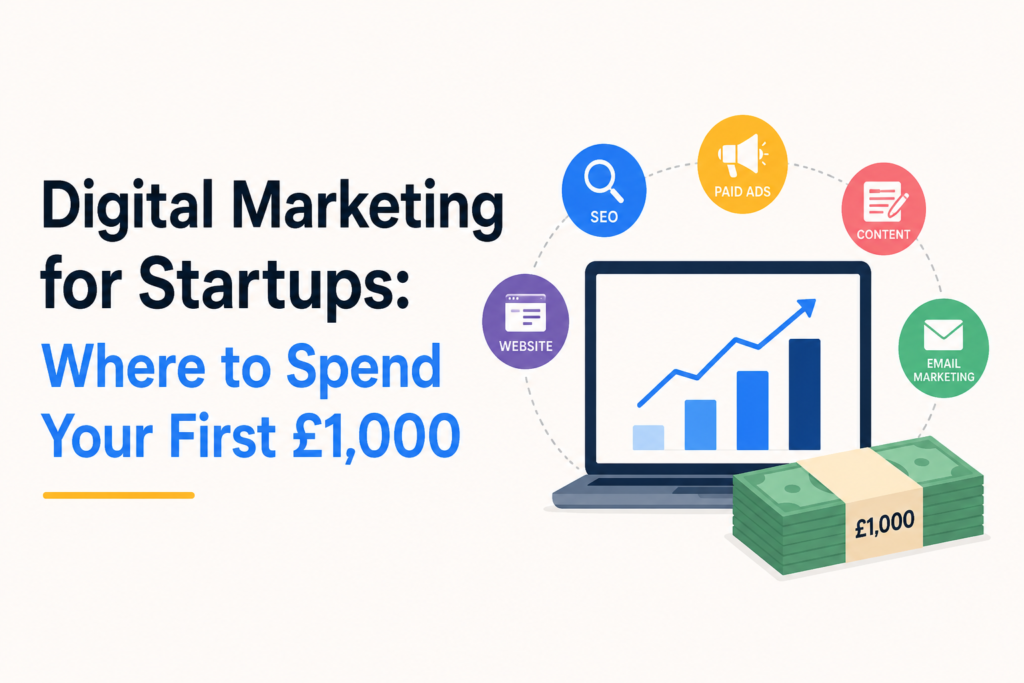
You’ve got £1,000 sitting in your Digital Marketing budget and a startup that needs customers yesterday. Every pound matters. Spend it wrong and you’ll have nothing to show for it but a sad analytics dashboard. Spend it right and you’ll have real traction, real data, and a repeatable engine you can actually scale.
This isn’t a generic “here are 10 marketing channels” post. This is the honest, boots-on-the-ground guide for UK founders who are building something real and need to make every quid count.
Let’s get into it.
Why Most Startups Waste Their First Marketing Budget
Before we talk about where to spend, let’s talk about where founders typically go wrong.
The most common mistake? Spreading £1,000 across five different channels and getting mediocre results on all of them. You run a bit of Google Ads here, boost a few Instagram posts there, pay for a directory listing, buy a Mailchimp subscription, and call it “an omnichannel strategy.”
It isn’t. It’s noise.
The second mistake is paying for visibility before you’ve validated your message. It doesn’t matter how many people see your ad if the ad says the wrong thing to the wrong person.
The third and this one stings is investing in marketing before your digital product is ready to convert. If your website loads slowly, looks broken on mobile, or leaves visitors confused about what you actually do, you’re pouring water into a leaky bucket.
At RemoteDev.uk, we see this constantly with early-stage founders. They’ll spend hundreds on paid traffic and then wonder why nobody’s converting only to discover the landing page has a four-second load time and a contact form that doesn’t work on Safari.
Fix the foundation first. Then market.
The £1,000 Framework: Where to Actually Spend It
Here’s the breakdown we’d recommend for a typical UK startup in its early stages. This isn’t one-size-fits-all your industry, product type, and target audience will shift the numbers but this is the thinking framework that works.
£300 Your Website and Landing Page (The Non-Negotiable)
If your current website was built on a free template in an afternoon and hasn’t been touched since, this is where your first £300 goes.
You don’t need a complete redesign. You need a single, high-converting landing page that does three things:
- Tells a visitor exactly what you do in under five seconds
- Speaks to a specific pain point they have right now
- Has a clear, frictionless call to action
That’s it. One page. One job.
A well-built landing page built by professionals or even a polished WordPress or Webflow page with the right copywriting will do more for your marketing ROI than any ad campaign aimed at a generic homepage.
What this budget covers: A professional landing page build, basic on-page SEO (meta titles, descriptions, heading structure), mobile optimisation, and a contact or lead-capture form that actually works.
What you get out of it: A page you can confidently send traffic to, knowing it’s doing its job.
RemoteDev tip: If you’re building an MVP or launching a new digital product, your landing page and your product should be developed together not as an afterthought. We build landing pages as part of our MVP development process so that by the time you’re ready to market, your conversion foundation is already solid.
£250 Content and SEO (The Long Game That Pays Forever)
Paid ads stop the moment you stop paying. SEO keeps working in the background, compounding over time like interest in a savings account you forgot you had.
For £250, you can invest in the foundation of a content strategy that will drive organic traffic for months and years without spending another penny.
Here’s what that looks like practically:
Keyword research (DIY or cheap tool): Use tools like Ubersuggest (affordable paid plan), Google Search Console (free), or AnswerThePublic (limited free tier) to find the exact phrases your potential customers are typing into Google. You’re not looking for high-volume keywords you’re looking for high-intent, low-competition terms specific to your niche.
For example, a fintech startup targeting UK freelancers doesn’t want to rank for “accounting software.” They want to rank for “best accounting app for UK contractors” or “how to do self-assessment as a freelancer.” Specific. Intentional. Winnable.
Two to three foundational blog posts: Hire a specialist freelance writer (check PeoplePerHour, Bark.co, or LinkedIn for UK-based content writers) to produce two or three genuinely useful, well-researched pieces based on those keywords. Not thin, AI-spun fluff actual helpful content that your target customer would bookmark and share.
Budget around £80–£120 per article for good quality. These posts won’t rank overnight, but within three to six months, they’ll start driving consistent, free traffic.
On-page SEO basics: Make sure every page on your site has a proper title tag, meta description, H1 heading, and is indexed by Google Search Console. These are free to implement and shockingly often missed.
£250 Targeted Paid Social (Fast Feedback, Not Just Traffic)
Here’s the dirty secret about paid social for startups: you’re not running it to get customers. Not yet. You’re running it to learn.
With £250 of well-deployed Meta Ads (Facebook and Instagram), you can test your messaging, your offer, and your audience assumptions and get data back in 72 hours that would otherwise take months of guesswork.
How to do this right
Run two or three ad variations with different headlines or value propositions. Keep the visuals simple clean, direct creative outperforms flashy design at this stage. Set a tight, specific audience. If you’re a B2B SaaS targeting London-based operations managers, don’t target “UK business owners aged 25–55.” That’s too broad.
Keep your daily budget at £10–£15 and run for two weeks. Look at click-through rates and cost-per-click not just impressions. If one ad has a dramatically higher CTR, that’s your market telling you which message resonates. That’s worth more than 10,000 followers.
LinkedIn Ads for B2B: If you’re targeting businesses rather than consumers, consider splitting this budget between Meta and LinkedIn. LinkedIn is more expensive per click, but the targeting precision by job title, company size, and industry is unmatched for B2B startups.
£150 Email List Building (Own Your Audience)
Every follower you have on social media is rented. The platform can change its algorithm, restrict your reach, or disappear entirely (remember when everyone moved away from Twitter?) and you lose access overnight.
Your email list is the one audience channel you actually own.
For £150, you can set up a proper email capture and nurture system:
- Email platform: Mailchimp’s free tier covers up to 500 contacts. ConvertKit has a free plan too. For UK GDPR compliance, make sure your sign-up forms include a clear consent checkbox.
- Lead magnet: Give people a reason to hand over their email. A short PDF guide, a free audit, a useful template, or a discount code. Whatever your business offers, there’s a lead magnet in there somewhere.
- Welcome sequence: Write three to five emails that go out automatically when someone subscribes. Introduce yourself, demonstrate value, and make a soft offer. This is your automated sales conversation, working while you sleep.
Remaining budget goes toward a freelance copywriter to help you write the welcome sequence if writing isn’t your strong suit. A well-written email sequence is an asset you’ll use for years.
£50 Analytics Setup (Because Flying Blind Is Expensive)
This sounds boring. It is, a little. But spending £50 (mostly on a freelancer’s time to set things up properly) on analytics means that every future marketing pound you spend is measurable.
At minimum, you need:
- Google Analytics 4 properly installed and configured
- Google Search Console set up and verified
- Goal tracking so you can see which channels are driving actual leads or sign-ups not just visits
Without this, you’re guessing. With it, you’re making decisions. That distinction becomes more valuable the more you spend.
The Channels You Can Probably Skip (For Now)
Not everything needs to be in your first £1,000. Here’s what can wait.
Influencer marketing: Unless you have a very specific product and a very specific creator audience in mind, this is a lottery at early stage. Save it for when you have validated product-market fit.
PR and press outreach: A good story placed in the right publication can be transformative but it usually requires time, relationships, and a bit of luck. At this stage, organic content and paid social give you more controllable results.
Podcast advertising: Great for brand awareness at scale. At sub-£1,000 budgets, the attribution is messy and the returns are hard to measure.
SEO agencies on retainer: A good SEO agency is worth its weight in gold but not at £1,000 total. Build your foundation yourself first, then bring in specialists when you have something to build on.
A Real-World Example: How This Plays Out
Let’s say you’re a UK-based startup that’s built a project management tool for creative agencies. Here’s how this budget might work in practice:
You spend £300 getting your landing page rebuilt with clear messaging: “Stop losing briefs and deadlines in your inbox. The project tool built for creative teams.” Clean. Specific. Targeted.
You invest £250 in two blog posts: “How to manage client briefs without the chaos” and “Why most creative agency PM tools fail (and what to use instead).” Both target long-tail keywords your future customers are searching for.
You put £250 into two weeks of Meta Ads targeting creative directors and agency owners in the UK, testing three different value propositions. You discover that “never miss a client deadline again” dramatically outperforms your other messages.
You set up an email list with a lead magnet: a free “Client Brief Template Pack” something genuinely useful to your audience. You write a five-email welcome sequence that introduces your tool and drives free trial sign-ups.
You spend the last £50 getting your analytics set up properly so you know which blog post drives the most sign-ups and which ad creative performs best.
In thirty days, you have a working content strategy, a tested message, a growing email list, and real data to guide your next investment. That’s a solid foundation for £1,000.
The Mindset That Makes the Difference
Here’s what separates the startups that get traction from the ones that burn through their budget with nothing to show
They treat marketing as an experiment, not an expense. Every pound is a test. Every result is data. They stay curious, not attached.
They go deep before they go wide. One channel done brilliantly beats five channels done badly, every time.
They build before they broadcast. Great marketing sends people somewhere worth going. If your product, website, or MVP isn’t ready to impress fix that first.
They document everything. What worked, what didn’t, what they’d do differently. Your future self will thank your present self for keeping notes.
Your Next Step
If you’re a UK startup trying to grow, the biggest thing we’ve learned working with founders across London and beyond is this: the companies that scale fastest aren’t the ones with the biggest budgets. They’re the ones that built the right digital foundation and then marketed it intelligently.
At RemoteDev.uk, we help startups build exactly that fast-loading websites, high-converting MVPs, and digital products that are ready to be marketed from day one. We’ve seen firsthand what a well-built product does for your marketing ROI, and we’ve seen the opposite, too.
If you’re not sure whether your digital foundation is ready for paid marketing, book a free 30-minute consultation with our team. No sales pressure. Just honest advice.
Because the best marketing in the world won’t save a product that isn’t ready to be found.
RemoteDev.uk is a UK-based remote development company helping startups and growing businesses build web apps, mobile apps, and MVPs fast, scalable, and cost-effective. Get in touch today.