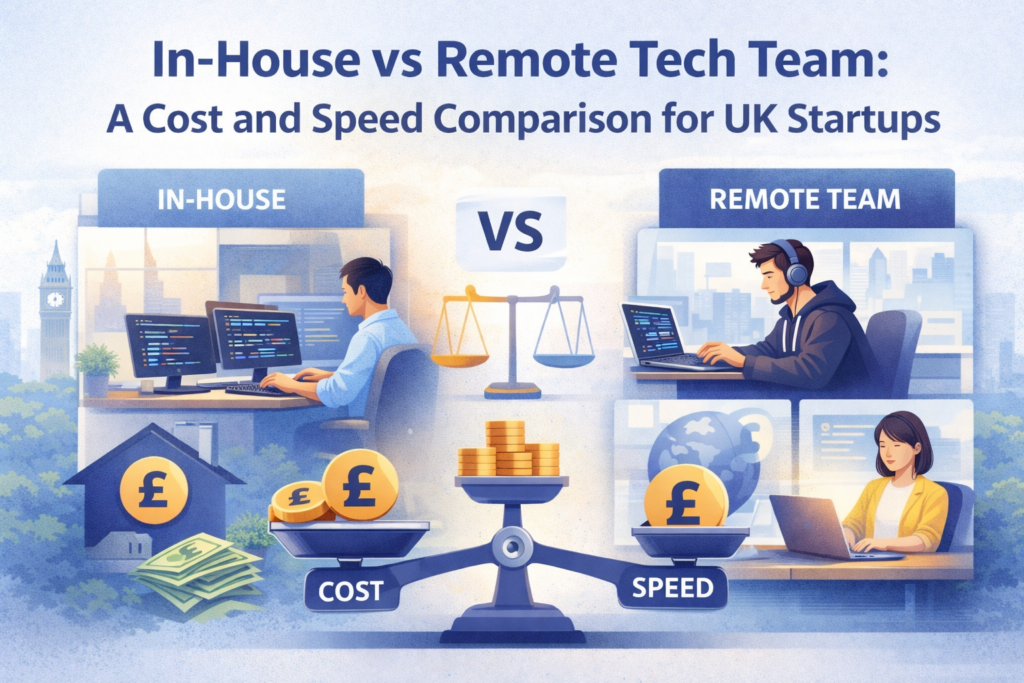
Every founder hits the same crossroads early on: do you hire developers into the office, or do you build with a remote teamRemote Tech ? It sounds like a straightforward operational decision, but for UK startups especially those navigating post-Brexit talent costs, a tight funding runway, and pressure to ship fast it’s one of the most consequential calls you’ll make in your first year.
This guide breaks down the real numbers, the hidden trade-offs, and what actually moves the needle on speed and quality. No fluff, no consultant-speak just an honest comparison built for founders who need answers.
The True Cost of an In-House Tech Team in the UK
Let’s start with money, because it’s usually what makes this decision for you.
Hiring a mid-level software developer in London will cost you anywhere between £55,000 and £80,000 in base salary alone. Add employer National Insurance contributions (13.8% above the threshold), pension auto-enrolment, equipment, software licences, and a seat in a Central London office, and you’re looking at a fully-loaded annual cost of £90,000 to £120,000 per developer.
And that’s one person. A functional startup tech team let’s say a backend developer, a frontend developer, and a product designer starts at £270,000 to £360,000 per year before a single line of product code ships.
Then there’s the time cost. The average time to hire a developer in the UK is 6 to 12 weeks. Technical screening, multiple interview rounds, notice periods it adds up. If you’re pre-revenue or mid-sprint, that’s months of lost momentum.
Hidden In-House Costs Founders Forget
- Onboarding and ramp-up time: Most developers need 4 to 8 weeks before they’re fully productive in a new codebase.
- Employee churn: The UK tech sector has a median tenure of around 2 years. Replacing a developer costs roughly 50–200% of their annual salary when you factor in recruitment fees and productivity loss.
- Office overhead: Even a hot-desking arrangement in a London co-working space adds £500–£1,500 per desk per month.
- Scope creep in team size: Once you hire in-house, there’s internal pressure to keep the team busy even during quieter product phases.
The Real Cost of a Remote Tech Team
Remote development when done properly through a structured partner like RemoteDev.uk operates on a fundamentally different economic model.
Instead of paying for a body in a seat 52 weeks a year, you’re paying for outcomes: features shipped, MVPs launched, code that works.
A quality remote development team based in the UK (but operating with distributed talent) can typically deliver comparable work at 40–60% of the equivalent in-house cost. RemoteDev.uk, for instance, positions itself on launching MVPs at 5x lower cost than traditional in-house builds not by cutting corners, but by eliminating the structural overhead that inflates in-house costs.
What You’re Actually Paying For With Remote
- Experienced developers who are already onboarded, tooled up, and working across modern stacks (React, Flutter, Node.js, Laravel)
- No recruitment lag teams can typically spin up within days, not months
- Flexible engagement models: project-based, sprint-based, or dedicated developer hire
- Predictable monthly costs with no NI, pension, or equipment overhead
Speed to Market: Where the Gap Really Opens Up
Cost matters, but for most early-stage startups, speed is the existential variable. You’re racing to validate your idea before competitors or before your runway runs out.
In-House: Slower Than You Think
Even after hiring, an in-house team goes through discovery, technical planning, environment setup, and sprint rituals before shipping anything. For a startup building its first product, 3 to 6 months before a testable MVP is common.
Add the hiring time and you’re potentially 9 months in before you get real user feedback. That’s a significant risk when you’re pre-product-market-fit.
Remote Teams: Built for Launch Velocity
A specialised remote team one that has already built dozens of MVPs brings two things an in-house hire can’t: pattern recognition and parallel capacity.
They’ve seen your problem before. They know which shortcuts are acceptable and which cut corners you’ll regret at scale. They can run design, frontend, backend, and QA in parallel rather than sequentially.
RemoteDev.uk’s headline proposition launching MVPs 10x faster isn’t marketing hyperbole. It reflects what happens when you engage a team that treats your project the way a Formula 1 pit crew treats a tyre change: practiced, coordinated, and ruthlessly efficient.
Realistic time to testable MVP
- In-house team (from hire): 6–12 months
- Freelance developers: 3–6 months (higher coordination cost)
- Structured remote team: 4–8 weeks
Quality and Control: Addressing the Elephant in the Room
The most common pushback founders give about remote teams is: “But how do I know the code will be good?” and “What if I lose control of the product?”
These are fair concerns and they’re usually rooted in a bad experience with unvetted freelancers from generic marketplace platforms, not with professional remote development companies.
The distinction matters. A vetted UK-led remote team operates with:
- Daily standups and async updates via Slack or Notion
- Version-controlled code on GitHub with PR reviews and documentation
- Sprint demos so you see working software every 1–2 weeks, not just a big reveal at the end
- Transparent project management through Jira, Linear, or equivalent tools
When you hire through a company like RemoteDev.uk, you’re not guessing at quality you’re engaging a partner with client testimonials, case studies, and accountability built into the process.
In contrast, an in-house hire gives you physical proximity but not necessarily better code. A mediocre developer sitting at a desk in your office is still producing mediocre code.
Flexibility: The Advantage That Compounds Over Time
Startups don’t grow linearly. You’ll have intense build phases, then periods of consolidation. You’ll pivot. You’ll add a feature you didn’t plan for and descale one you thought was core.
An in-house team is structurally inflexible. You can’t dial headcount up or down without painful, expensive, and demoralising redundancy processes.
A remote team scales with you. You can go from one developer to five in a sprint, or drop back to a maintenance retainer after launch. That flexibility is not just convenient it preserves capital during lean phases and maximises output during growth phases.
When In-House Actually Makes Sense
To be fair, there are scenarios where building an in-house team is the right call
- You’ve found product-market fit and are scaling fast at Series A and beyond, with predictable roadmaps, in-house teams become easier to justify.
- Your product has deep regulatory or IP sensitivity if you’re in fintech, healthtech, or defence, you may have compliance reasons to keep certain functions internal.
- Your culture is a core differentiator if your team identity is central to your brand and customer experience, physical co-location can reinforce it.
- You have the runway and patience if you’re not in a rush and have 12+ months of funding, the calculus changes.
But for the majority of UK startups in early stages pre-revenue, pre-Series A, or building their first digital product these conditions don’t apply yet.
A Side-by-Side Comparison
| Factor | In-House Team | Remote Team (e.g. RemoteDev.uk) |
|---|---|---|
| Annual cost (3 developers) | £270K–£360K | £80K–£150K |
| Time to first hire | 6–12 weeks | 1–5 days |
| Time to MVP | 6–12 months | 4–8 weeks |
| Scalability | Low (redundancy risk) | High (flexible contracts) |
| IP and code ownership | Yes | Yes (with proper contracts) |
| Communication | High (co-located) | High (async tools + standups) |
| Overhead (office, equipment, NI) | Very high | None |
| Suitable for | Post-PMF scaling | Early-stage build and validate |
What UK Startups Are Actually Choosing in 2026
The conversation has shifted. Remote-first development is no longer a compromise it’s a strategy. UK startups from London to Manchester to Edinburgh are choosing remote-first build partners not because they can’t afford local teams, but because they’ve done the maths and spoken to founders who’ve been through both models.
The pattern is consistent: founders who built in-house from day one often wish they’d validated faster and cheaper first. Founders who used a structured remote partner to launch their MVP, then hired in-house once they had traction, typically describe it as one of their best early decisions.
Final Verdict
If you’re an early-stage UK startup trying to build your first product, validate an idea, or launch an MVP within the next 90 days, the remote team model wins on almost every metric that matters right now: cost, speed, flexibility, and risk.
The in-house model has a place but it’s the right tool for a later stage of the journey, not the first sprint.
If you’re ready to explore what a remote development team could build for you, RemoteDev.uk offers a 1-week free trial and a free 30-minute consultation. They’ve helped 250+ businesses launch faster and leaner and they’re UK-based, which means you’re not dealing with time-zone chaos or cultural miscommunication.